
How it works
From five questions to getting paid.
Answer five questions, hear back in 10 minutes, fill in a short form, and our buyers price your records within 24 hours. It costs you nothing.
What’s my data worth?- 1
Tell us about your business
Five questions in the chat on the home page: what you do, how many people, the records you keep, where you are based and how long you have run. Under five minutes. No files, no logins.
- 2
Hear back in 10 minutes
We read your answers and email you. If your records fit what our buyers look for, the email has the link to a short form. If a partner suits you better, we point you to one.
- 3
Fill in a short form
About 20 minutes at korra.io/form, with the details buyers ask about. It saves as you go, and you sign in with a code we email you. You can sign an NDA with Korra there first.
- 4
Buyers make offers
Approved buyers see a short description of your records, without your name or your company's name. They price it within 24 hours of your form being in, and we email you the price.
- 5
Get paid
If you say yes, you and the buyer sign the terms and you hand over a copy. The buyer pays you, as fast as 7 days, usually net 30. You pay Korra nothing.
What “selling data” means here.
You do not sell your business or your systems. You license a copy of past records for uses you agree. A licence gives a buyer permission to use that copy. It does not by itself transfer ownership.
Nobody gets into your systems. The buyer gets only the copy you agree to send, in the way you agree to send it.
What you keep
- Ownership of your records
- Your systems, closed to buyers
- The choice of who else can license the same records
- The right to say no to any price
What you describe.
Eight kinds of records, each with a plain example. You do not upload anything. You tell us what you have in the chat and the short form.

Team conversations
The discussion behind a decision.
See an example
Business email
Requests, replies, and the work between.
See an example
Sales records
From first inquiry to a recorded outcome.
See an example
Customer support
A problem, a response, a resolution.
See an example
Documents and guides
The knowledge that makes a task possible.
See an example
Approved call transcripts
Spoken work, with the right permissions.
See an exampleOperational workflows
The steps, rules, and exceptions of a task.
See an example
AI review and feedback
An output, a correction, and the reason.
See an exampleWhat buyers see.
Approved buyers see a short description of your records, without your name or your company’s name. A buyer learns who you are only if you choose to go ahead.
You can sign an NDA with Korra on your form page before you share details. Removing names does not make records anonymous, so you decide what stays out of any copy you send.
In the description
- The record type
- A rough size, not an exact count
- The years the records cover
- The uses you allow
Your price.
Once your form is in, our buyers price your records within 24 hours. We email you the price. Nothing is binding, and you can say no.
If you say yes, you and the buyer agree the licence, the delivery and the payment in writing. Korra is not a party to your agreement.
Where things stand
- Form in
- Form checked
- With buyers
- Price ready
- In talks
- Done
Your form page at korra.io/form shows each step, and we email you as it moves.
Terms and payment.
The price and the payment date go in writing between you and the buyer. Payment can come as fast as 7 days; usual terms are net 30. The typical range is between $200K and $2M. What buyers offer sets your number.
- What you describe
- What your business does, the records you keep, where they live and how far back they go. In the chat, then in the short form. You do not upload anything.
- What buyers see
- A short description of your records: the record type, a rough size, the years covered and the uses you allow. Your name and your company's name stay out of it.
- Your price
- Our buyers price your records within 24 hours of your form being in. We email you the price. Nothing is binding, and you can say no.
- Your agreement, between you
- If you say yes, you and the buyer agree the licence, the delivery and the payment in writing. Korra is not a party to your agreement.
- How you get paid
- The buyer pays you the price you agree. Payment can come as fast as 7 days; usual terms are net 30. You pay Korra nothing.
What it costs you.
Nothing. The buyer pays you the price you agree and pays Korra’s fee on top. The fee does not come out of your price.
Your part, in time
- Five questions in the chat, under five minutes
- The short form, about 20 minutes
- Answer buyer questions when you choose
- Say yes or no to the price
Korra connects you with buyers and keeps you posted by email.
Watch: how it works in 60 seconds
License your data. Get paid.
Answer five quick questions and hear back from us in 10 minutes. Nothing to upload, and it costs you nothing.
Questions owners ask.
How do I find out what my data is worth?
Answer five questions in the chat on the home page. We read your answers and email you within 10 minutes. If your records fit, the next step is a short form, and our buyers price it within 24 hours of the form being in. It costs you nothing.
What records count?
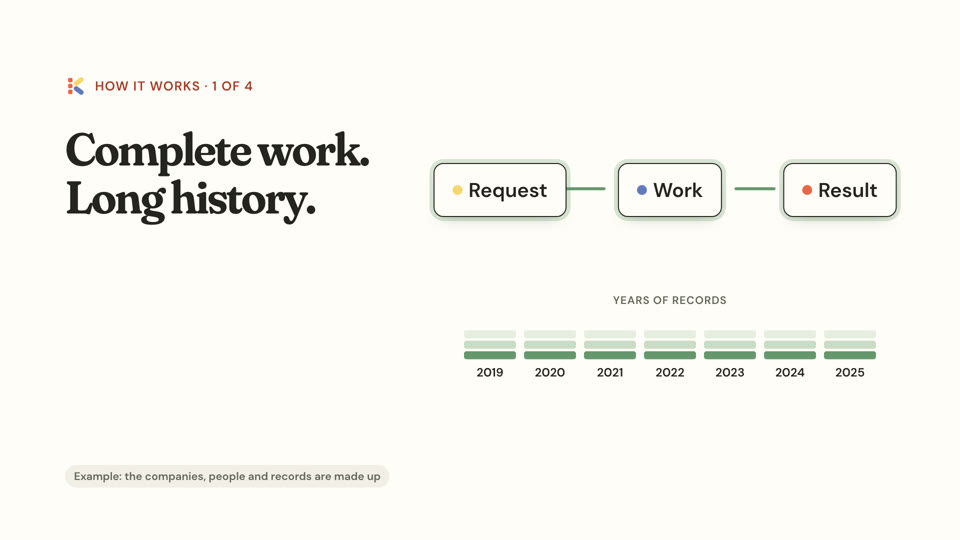
Records your business owns that show real work: emails, team chats, sales records, support tickets, documents, call transcripts, task histories, and saved AI reviews. Good records show a request, the work, and the result.
Do I need to upload files?
No. You describe your records in the chat and the form: the record type, the years, a rough count, and what to leave out. Your files stay in your systems.
How long does it take?
Under five minutes for the chat, then about 20 minutes for the form if your records fit. The form saves as you go, so you can stop and come back.
What happens after the chat?
Within 10 minutes we email you. If your records fit what our buyers look for, the email has the link to the short form. If a partner suits you better, we point you to one.
Who sees my details?
Buyers see a short description of your records without your name or your company's name. You can sign an NDA with Korra on your form page before you share details. A buyer learns who you are only if you choose to go ahead.
Can I say no?
Yes. Nothing is binding until you sign. You can say no to any price, and you can stop at any point.
How much could I get?
The typical range is between $200K and $2M. What buyers offer for your records sets your number. No sale is guaranteed.
What is Korra's fee?
The buyer pays it, on top of the price you agree. You pay Korra nothing, and the fee does not come out of your price.
How fast do I get paid?
You and the buyer set the price and the date in writing. Payment can come as fast as 7 days; usual terms are net 30.
Does Korra handle my files?
No. Korra connects you with buyers. You and the buyer agree how records move between you.
Do I give up my data?
No. You license a copy of past records and keep ownership. Buyers never get live access to your systems, and you choose whether a licence is exclusive.
Are my records anonymous?
No. Removing names does not make records anonymous. Before you share anything, you decide what stays out and how the copy is prepared.
Is Korra the buyer?
No. Korra connects you with buyers. The buyer is the company whose price you accept, and the licence is between you and that buyer.
Can a small company take part?
Yes. Complete examples of real work matter as much as volume. Start with the five questions.
What if I am unsure about permissions?
Say so in the chat or the form. Check customer terms, employee information, and material owned by others with your own adviser before you sign a licence.
Can I license records that belong to my clients?
Usually not. Only records your business owns and can share. Agencies, accountants, and law firms often hold client files they may not license.